

01· The surplus
There has never been more fitness information available, and it has never been easier to reach. A programme, a nutrition plan, a demonstration of any exercise and an opinion on all three, all before the kettle boils.
And yet the same thing happens. People start. People stop. Somewhere in the third or fourth week the whole thing quietly dissolves.
The obvious conclusion is that people need better information.
We do not believe that. The information is already there, free, and most people can recite it. What is missing is everything that turns knowing into doing.
02· The wrong diagnosis
When it falls apart, most people decide they are not disciplined enough.
It is a tidy story and it is almost always wrong. The same person holds down a job, raises children and keeps promises to everyone else.
What is missing is structure. A plan written for the week they actually have, a way to see whether it is working, and somebody who notices when they go quiet.
The distinction matters. If the problem is the person, the answer is to try harder, which has already failed.
If the problem is the design around the person, the answer is to build something better. That is the problem we work on.
03· What closes the gap
Two findings shape how we build. In one study of people forming a new daily behaviour, the median time to reach automaticity was about 66 days, with a range from 18 days to well beyond 200, and missing a single day did not undo the progress. (Lally et al., 2010)
And a meta-analysis of 138 studies covering close to 20,000 participants found that prompting people to monitor progress towards a goal raised the rate at which goals were reached, with a stronger effect when progress was recorded or reported to somebody else. (Harkin et al., 2016)
So the early weeks need support rather than enthusiasm, and progress needs to be recorded and read by someone.
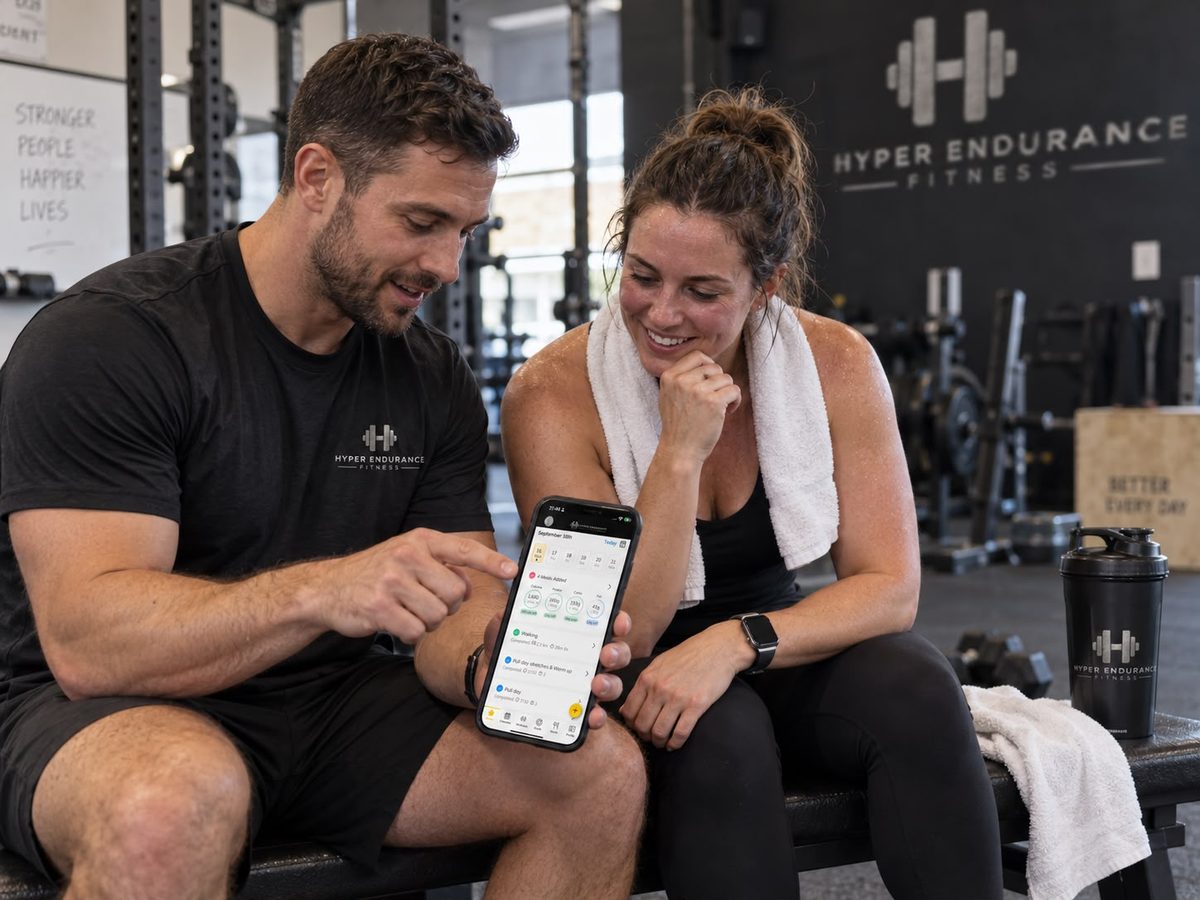
That is why the App is built the way it is. Sessions logged. Loads recorded. Weight plotted against a weekly average. Check ins answered by a coach.
Once there is a record, a bad week stops being proof that you cannot do this.
04· The Endurance Method
Four disciplines carry it. Each one exists because of a specific reason people stop, and they work as one system rather than four features.
- TrainA programme built for the body you have now, the equipment you can reach and the time you actually own, progressed as you develop.
- FuelNutrition guidance built around how you already eat, so it survives a long day, a work trip and a weekend out.
- ProgressTracking that turns effort into evidence, so there is something factual to look at when the week has been hard.
- BelongA membership holding the same standard and a coaching team in contact, so going quiet gets noticed.

Alongside them sits the Reset Protocol, for the weeks that do not go well. A system that only works in a good week is how most programmes fail.
05· What we will not do
We do not promise a timeline for somebody else’s body.
We do not trade on shame, invented deadlines, or photographs chosen to make a stranger feel behind. We do not sell a plan and disappear.
We also do not claim to be the biggest or the first at anything.
We would rather be judged on what a member can point to after three months. A programme that fits their week. A record of what they did. A coach who answered.
06· Why this can be global
The feeling of being stuck does not belong to one country, one age or one kind of person.
What has changed is reach. Delivered through an App, one documented method holds the same standard for a member training at six in the morning and a member training after a night shift, in different countries, with different equipment and different food around them.
Our mission is to change the lives of millions of people through accessible, high quality coaching.
A statement like that is worthless unless it changes what gets built, so it decides three things here. The method is documented rather than dependent on one coach. It is designed around the difficult week rather than the ideal one. And the same coaching sits behind every term, so the only difference between memberships is how long you commit for.

We are early in this, and we would rather say so plainly than dress the company up as something it has not yet become.
07· Where this leaves you
If you already know what to do and it still is not happening, nothing here is asking you to want it more.
The missing part was never desire. It was a programme written for your real week, guidance on eating that fits your life, a record that proves it is working, and somebody who notices when you stop.
That is what we build. Become stronger than you were before is not a line we add at the end. It is what the whole system is arranged around.
The short version
- The shortage is not information. It is the structure that turns information into consistent action.
- Stopping is usually a design problem in the programme rather than a character problem in the person.
- Evidence changes belief. What gets recorded is what gets trusted when a week goes badly.
- One documented method, delivered through an App, can hold the same standard anywhere.
08· Sources
Lally, P., van Jaarsveld, C. H. M., Potts, H. W. W., and Wardle, J. (2010). How are habits formed: modelling habit formation in the real world. European Journal of Social Psychology, 40(6), 998 to 1009. Read the study
Harkin, B., Webb, T. L., Chang, B. P. I., Prestwich, A., Conner, M., Kellar, I., Benn, Y., and Sheeran, P. (2016). Does monitoring goal progress promote goal attainment? A meta-analysis of the experimental evidence. Psychological Bulletin, 142(2), 198 to 229. Read the study
Training is not a substitute for medical or mental health care. If you have a health condition, or you are unsure whether an activity suits you, speak to a qualified healthcare professional first.
If this is the part that has been missing
One programme written around your week, nutrition guidance that fits how you already eat, tracking that makes progress visible, and a coaching team that stays in contact. All of it inside the Hyper Endurance Fitness App.
Memberships from 54.99 EUR every 28 days. Fourteen days to cancel for any reason.